
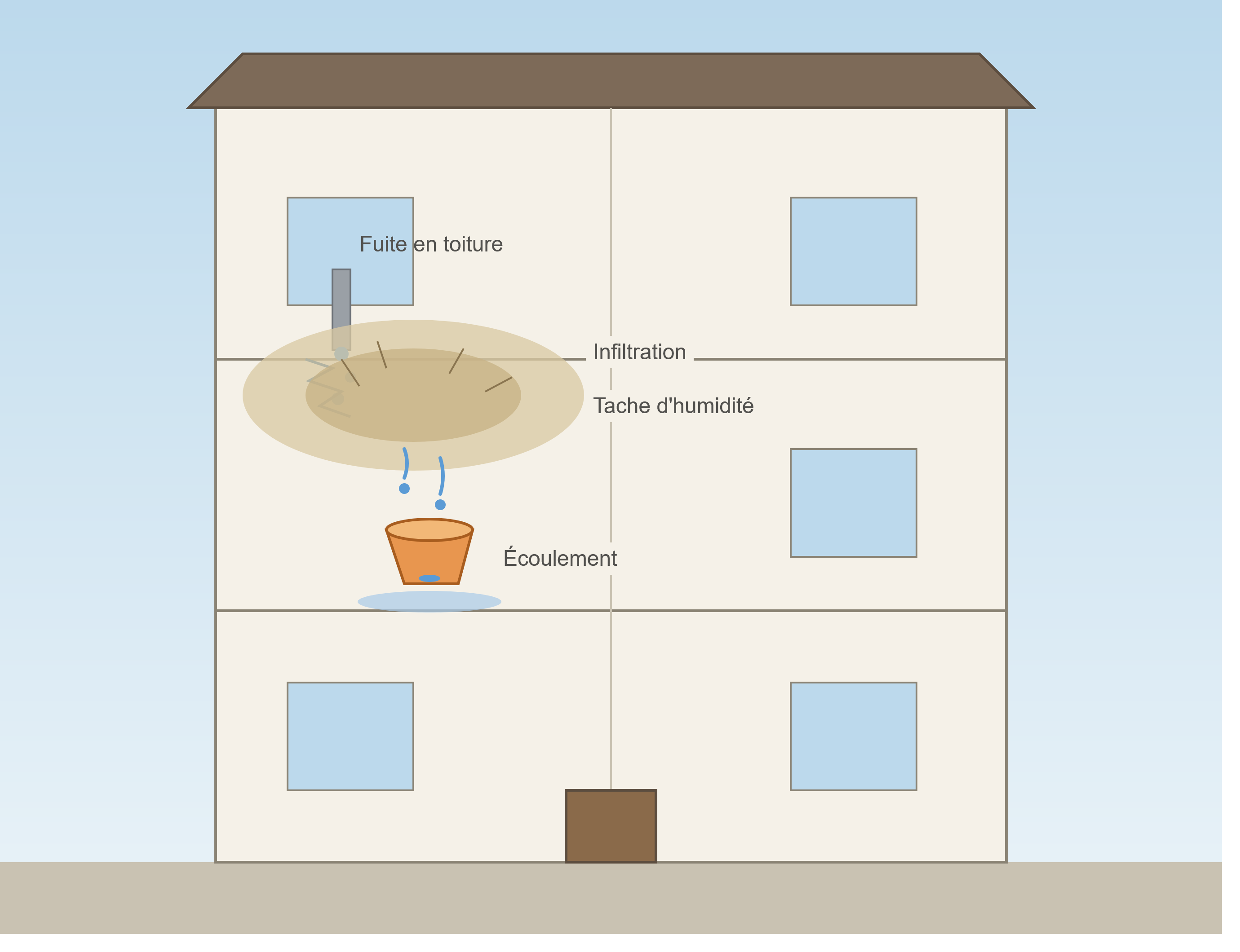
Home Insurance Water Damage Claim Handling Have you experienced water damage in your apartment within a condominium complex?
Regarding home insurance, water damage in an apartment is covered based on an indemnity principle (capped at the property's value) and subject to policy exclusions;
In principle, the insurer must cover accidental damage or damage caused by the insured's negligence, excluding intentional acts.
Claim handling: how does it work?
• reporting by the insured,
• assessment/inspection,
• offer of coverage or denial by the insurer,
Coverage that may include leak detection and restoration work, provided the damage falls under a covered risk.
Note: frequent exclusions apply to damage caused by mold, dampness, or lack of maintenance. In a condominium setting:
There is an overlap of policies :
- the occupant's insurance (tenant or owner-occupier),
- the non-occupying owner's insurance,
- and the condominium association's insurance;
Each may be triggered depending on the location of the leaking pipe (private vs. common area) and the status of the affected party (neighbor, condominium association, or third party), the condominium association is, in principle, strictly liable for damage originating from common areas, the liability of the co-owner responsible for a private pipe may be invoked under Article 1242, alinéa 1 of the Civil Code Judicial
Decisions of the Court of Appeal demonstrate the essential role of both amicable and court-ordered expert assessments in determining the source of a leak, liability for the damage, and the scope of repairs.
They also highlight the importance of the policyholder and the property manager (syndic) acting transparently and cooperatively regarding reporting and cooperation, as this affects whether coverage is maintained or forfeited.
Claim notification, expert assessment, and investigation Notification, starting point, and statute of limitations.
In all property damage contracts, the policyholder must report the loss to their insurer;
Consequence of failure to report or late reporting:
- forfeiture of coverage (provided the contract and Article L.113-2 so stipulate, subject to judicial review)
You have two years to take legal action against the insurer.
Regarding the statute of limitations:
if the contract does not validly state the two-year limitation period, that period cannot be enforced against the policyholder.
The limitation period for liability claims against the property manager or the co-ownership association is five years;
the five-year period begins on the day the co-owner becomes aware of the facts enabling them to take action—which could be the date of the first known water damage or the date the expert report is filed, depending on what information was available to the victim. Role of the amicable or court-appointed expert.
Property insurers appoint an amicable expert to assess the damage, determine the cause of the leak, and estimate repair costs, within a process involving all parties (adversarial procedure).
This does not constitute an agreement by the insurer to provide coverage!!!!
In the event of a dispute, the courts frequently rely on court-ordered expert assessments to establish the technical origin of the loss (private pipework vs. common areas, ventilation defects, façade cracks, dry rot, rising damp) and to quantify repair costs and damages. Interplay between occupant, building, and contractor insurance.
Occupant, non-occupant owner, and condominium association
In a condominium, every co-owner must hold civil liability insurance, whether they occupy the unit or not. The condominium association is required to hold insurance covering its own liability (Article 9-1 of the Law of July 10, 1965).
In practice, several policies exist:
- Comprehensive home insurance for the occupant,
- comprehensive insurance for the non-occupant owner (PNO), the association’s comprehensive building insurance,
- and potentially legal protection and structural damage insurance.
Occupant or non-occupant owner insurance covers damage to the insured private areas and—via the civil liability coverage—claims brought by the association or neighbors.
The association’s comprehensive building insurance covers damage to common areas and certain movable property located therein; the "water damage" coverage typically extends to "accidental ruptures, leaks, or overflows" in pipes and fixed installations, as well as leak detection costs resulting from covered damage.
The condominium association’s liability is automatically triggered—pursuant to Article 14 of the 1965 Law—for damage caused by a construction defect or a lack of maintenance in the common areas, unless the association can prove fault on the part of the victim or a third party.

Pas de contribution, soyez le premier